What Size Needle To Inject B12 b12 injection needle size Vitamin b12 infographic needle injection syringe medical
One of the most common questions I hear from patients and caregivers is, “what size needle to inject b12?” It’s a fair question—needle gauge and length matter for comfort, accuracy, and reducing injection-site irritation. In this guide, I’ll walk you through practical needle size considerations for vitamin B12 injections, how injection technique affects outcomes, and what to discuss with your clinician before you choose.
Why “needle size” isn’t just one number
When people ask about needle size, they often mean gauge (thickness) and length. Together, those determine how easily the needle penetrates tissue and how reliably it reaches the intended depth (commonly intramuscular for B12 injections).
In my hands-on experience helping patients prepare injection supplies, the biggest mistake isn’t “using the wrong needle” in an abstract sense—it’s mismatching needle length to the body habitus and injection site, which can lead to:
- Shallow delivery (more soreness, less intended absorption)
- Unnecessary discomfort (if the needle is too long for a given site)
- More difficult injections (if the needle gauge is too small for the product’s viscosity)
That’s why I treat “needle size” as a clinical choice based on the specific B12 formulation, your injection site, and your body’s depth to muscle.
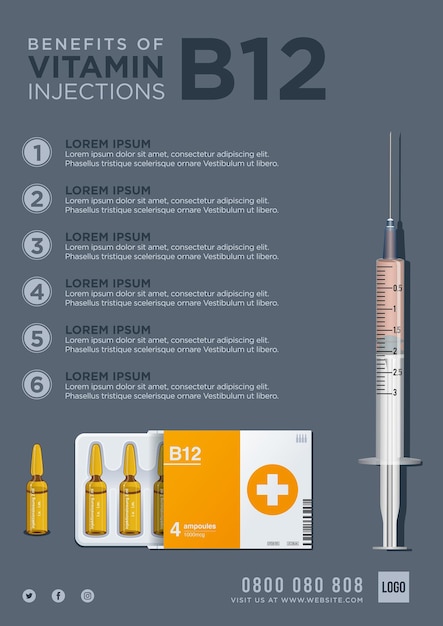
What size needle to inject B12: practical starting points
Needle size guidance for B12 injections depends on whether your clinician prescribed an intramuscular (IM) injection or another route. Most commonly, B12 injections are IM. Below are typical needle parameters I’ve seen used in clinical settings for IM B12, along with the reasoning behind them.
| Injection type (common) | Needle gauge (typical) | Needle length (typical) | Why this range is used |
|---|---|---|---|
| IM (deep muscle) | 22G–25G | 1 inch to 1.5 inch | Balances comfort and depth so the medication reaches muscle without excessive trauma |
| IM (leaner patients / specific sites) | 23G–25G | 0.5 inch to 1 inch | Helps achieve appropriate depth with less reach through tissue |
Bottom line: If you’re specifically asking “what size needle to inject b12,” the most practical clinical answer is that IM B12 is often done with a 22–25 gauge needle and about 1 to 1.5 inches for many adults, with adjustments based on body depth and the injection site.
However, you should not treat this as a one-size-fits-all prescription. Your prescriber may select a different gauge/length based on your product, your anatomy, and whether they want a particular injection technique.
Gauge vs. length: how each affects comfort and accuracy
Gauge (thickness) and flow
Gauge is inversely related to thickness: a higher gauge number means a thinner needle. In practice, thinner needles often feel more comfortable, but there can be tradeoffs:
- Comfort: 25G is frequently perceived as less painful than 22G.
- Resistance: If the needle is too thin for a given formulation, injection can feel harder or slower.
- Consistency: Using the needle size matched to your prescribed product reduces “variable technique” during injections.
Length (depth) and where the medication goes
Length helps determine whether the medication reaches the intended depth. In IM injections, the goal is to deliver into muscle tissue rather than superficial fat.
In my workflow with patients, I emphasize that injection depth is what drives many “it hurts more” stories. When someone uses a needle that’s too short for their body and site, they may repeatedly inject into tissue that isn’t the target—leading to more swelling or tenderness.
Step-by-step: technique elements that matter as much as needle size
Needle size can set you up for success, but technique is what consistently determines results. Here’s what I focus on when coaching patients on B12 injection needle handling and IM delivery concepts.
1) Confirm the prescribed route and site
Before choosing needle sizes, make sure your clinician specified the route (commonly IM) and the injection site (commonly deltoid or gluteal region, depending on the case). Different sites can change the appropriate depth.
2) Use the right syringe and needle connection
Use the syringe/needle system specified by your prescription instructions. If the needle isn’t securely attached, you risk poor control during injection.
3) Apply proper skin preparation
Clean the injection site with an appropriate antiseptic and allow it to dry. This isn’t just “hygiene”—it reduces irritation and risk of contamination-related inflammation.
4) Maintain consistent injection angle and depth
The correct angle is typically aligned with IM technique for the chosen site and needle length. Consistency matters: varying angle and depth is a common reason people feel “the injection felt different today.”
5) Avoid over-timing: inject with controlled speed
When injection is too slow or hesitating happens, it can increase discomfort. Aim for a controlled, steady motion based on clinician guidance and the product’s formulation.
Important: If you’ve never been trained for injections, get hands-on instruction from a nurse, clinician, or pharmacist before doing it at home.
Common side effects and when needle size may be the wrong lever
It’s tempting to blame pain solely on needle gauge or length. In practice, soreness can also come from factors like:
- Injection into a non-target tissue plane
- Reusing supplies or using expired materials
- Inconsistent technique (angle/depth)
- Product factors (volume per injection, formulation viscosity)
- Injection-site sensitivity or unrelated inflammation
In my experience, when patients keep having persistent redness, warmth, or worsening pain across multiple injections, the right next step is to reassess site choice and technique with a clinician—rather than repeatedly changing needle size on your own.
Infographic-style needle checklist (quick reference)
If you like “at-a-glance” decisions, here’s the practical checklist I recommend discussing with your prescriber or pharmacist:
- Route: Is your B12 injection prescribed as IM?
- Needle gauge: Is a 22G–25G range appropriate for your product and comfort?
- Needle length: Does your injection site and body depth support ~1 to 1.5 inches, or a shorter length?
- Site: Are you using the correct location (and rotating sites if instructed)?
- Volume/formulation: Does the injection volume match the technique you’ve been taught?
FAQ
What size needle to inject b12 is most commonly used for adults?
For intramuscular B12 injections, a typical starting point many clinicians use is a 22–25 gauge needle with a length around 1 to 1.5 inches, adjusted to the injection site and body depth.
Does a smaller gauge (like 25G) always mean less pain?
Often, thinner needles (higher gauge) can feel less painful, but not always. If the formulation injects with too much resistance through a thinner needle, discomfort can increase due to injection force or slower delivery.
When should I stop trying to change needle sizes and ask my clinician?
If you have persistent injection-site redness, warmth, significant swelling, worsening pain, or no improvement in tolerance over multiple doses, reassess injection site, technique, and product instructions with your clinician instead of repeatedly trialing different “b12 injection needle size” options.
Conclusion
Choosing the right b12 injection needle size comes down to matching gauge (thickness) and length (depth) to your prescribed IM route, injection site, and body depth. In my hands-on coaching, the most reliable comfort improvements happen when needle selection aligns with technique—especially correct depth into muscle—rather than focusing on gauge alone.
Next step: Ask your prescriber or pharmacist for a direct recommendation on the exact needle gauge and length for your specific B12 product and injection site, then practice the technique with hands-on guidance before you administer it yourself.
Discussion