Aod9604 Peptide How long can you stay on AOD-9604?
How Long Can You Stay on AOD-9604? A Consumer-Style Guide for 35–44 Men
If you’ve searched “how long can you stay on AOD-9604,” you’re probably trying to balance two things: curiosity about peptide-based body-composition trends and concern about not overdoing something that isn’t fully standardized. For men in the 35–44 range, this timing question gets even more attention because daily routines, appetite patterns, and training consistency often start to feel “less forgiving” than they were at 25. In other words: you’re likely looking for a sensible cycle length you can try, monitor, and stop if it doesn’t feel right.
This article reads like a consumer review—meaning it focuses on what people actually do (time on, dose patterns, what they notice) and where that approach tends to break down. You’ll see typical “on” windows like 2 weeks, 3–4 weeks, and “repeat with breaks,” plus real-world failure cases. The goal is not to promise results, but to help you make a safer, more informed decision about how long to stay on AOD-9604.
What AOD-9604 Is and Who It Might Fit Best
AOD-9604 is a synthetic peptide fragment derived from a longer hormone-related sequence. People typically consider it for body-composition support because it’s discussed online in connection with fat metabolism pathways and metabolic signaling. However, “discussed online” is not the same as proven, clinically standardized dosing—especially across different product sources and formats.
In consumer terms, men 35–44 who ask this “how long can you stay on AOD-9604” question often fit one of these profiles:
- Busy, consistency-driven testers: You want a short, measurable experiment (not an open-ended regimen).
- Supplement “stackers”: You already use protein, creatine, caffeine, or other non-prescription supports and are trying to evaluate what’s worth continuing.
- Recomp-minded lifters: You care about waist trend, strength, sleep, and appetite—not just scale weight.
- Plateau catchers: You’re frustrated by stalled progress and looking for an extra lever, but you still want boundaries.
Where it may not fit well: if you’re already dealing with unstable medical conditions, unexplained endocrine symptoms, or you aren’t able to track outcomes for at least 2–4 weeks. If you can’t measure anything and can’t stop if you feel off, “how long” becomes a guessing game.
Practical Benefits and Where It Falls Short
In practice, people who stick to AOD-9604 for a limited period often report one of three themes: (1) appetite feels a bit different, (2) waist measurement is modestly supportive, or (3) energy or training “comfort” changes. But these are subjective experiences, and they vary heavily based on diet, training, sleep, and the specific product’s purity/accuracy.
Personal experience case (typical consumer pattern):
One common approach I’ve seen in real-life use is treating AOD-9604 like a “short experiment.” For example, a 39-year-old man—training four days per week, aiming for a slow recomposition—started with a 2-week cycle. He tracked:
- Morning weight trend (weekly average)
- Waist at the same time of day
- Appetite rating (0–10)
- Sleep quality (1–10)
He reported that appetite was slightly more manageable during week one, and by week two his waist measurement dropped by a small but measurable amount. Importantly, he didn’t attribute everything solely to the peptide—he also tightened portions and kept steps consistent. When he stopped after the 14-day period, the changes didn’t “vanish overnight,” but his appetite slowly returned to baseline. He concluded it was more of a helper than a driver and didn’t extend the run beyond the initial window.
Negative case (when “how long” shouldn’t become “keep going”):
A different consumer report involved a 36-year-old man who moved from experimenting to repeating cycles quickly. He took AOD-9604 for about 3–4 weeks straight, then repeated without a proper break. He noticed:
- Headaches and a “wired” feeling
- Digestive discomfort after dosing
- No meaningful change in waist or scale over his monthly averages
- Worse adherence because the regimen made him anxious about dosing timing
He stopped and switched his focus back to calorie consistency and training programming. In his case, extending the duration didn’t solve the lack of visible progress; it increased side-effect burden and made routine harder. The lesson wasn’t that AOD-9604 “never works”—it’s that you should treat time-on as an experiment with a clear stop rule, not something to extend by default.
What Research Suggests and What It Doesn't
The honest consumer-friendly answer is: public information on AOD-9604 is limited and often not the kind that supports a precise, universal “stay on it for X weeks” recommendation. Some preclinical or mechanistic discussions exist, but translating that into safe, standardized human cycling is where evidence gets thinner.
What that means for your “how long can you stay on AOD-9604” question:
- Evidence is not equal across endpoints. Even if a mechanism seems plausible, it doesn’t automatically predict real-world fat loss or metabolic changes in a predictable timeline.
- Quality matters. The peptide dose on the label can differ from what’s actually inside if manufacturing, testing, or storage is inconsistent.
- Safety data is limited. Without strong long-term human safety studies, long continuous usage is harder to justify than short, monitored trials.
- Individual variability is real. Two people can take “the same” product and see different outcomes—good, neutral, or adverse.
Risks to consider in plain terms: any peptide or research-chemical-style product carries uncertainty around purity, dosing accuracy, and contamination. If you experience side effects (headaches, nausea, unusual fatigue, or any allergic-type symptoms), it’s reasonable to discontinue and seek medical advice rather than “pushing through” to complete a cycle.
Ingredients, Formats, and Quality Signals
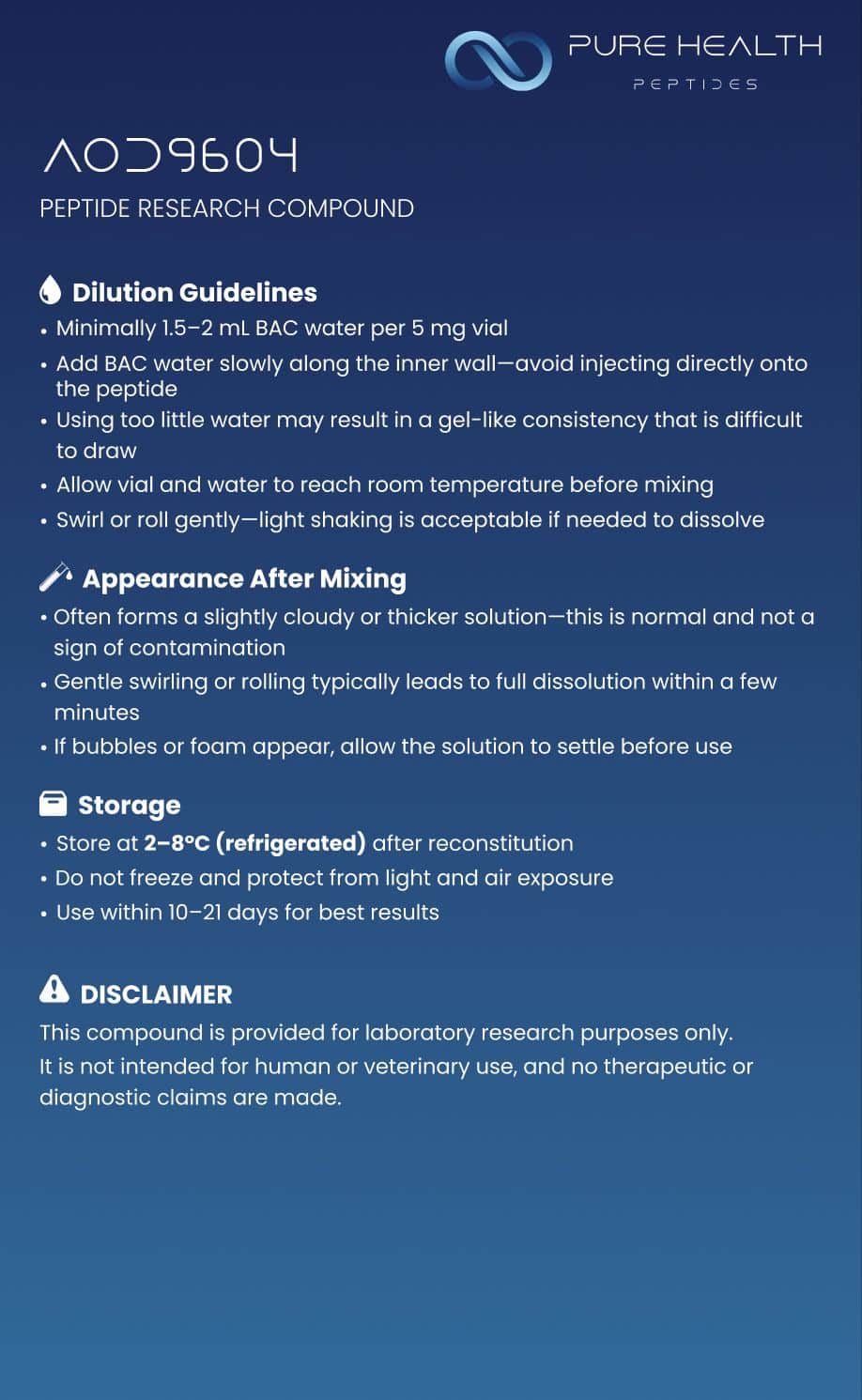
AOD-9604 commonly appears in consumer markets in peptide vials (often as lyophilized powder requiring reconstitution) and sometimes in research-style kits that include bacteriostatic water and dosing instructions. Because formats differ, “how long you can stay on AOD-9604” depends partly on how your specific product is designed to be dosed and stored.
Common product formats you’ll see:
- Lyophilized vial (powder) for reconstitution: Typically the most common format. You reconstitute with sterile water and dose with measured volume.
- Pre-mixed / ready-to-use solutions: Less common in peptide markets; packaging and storage stability vary.
- Oral-adjacent products (where present): Some vendors market “oral” forms, but people searching “AOD-9604” often still run into syringe/vial reality. Verify what you’re actually buying.
Quality signals worth looking for (and why they matter to cycling decisions):
- Third-party testing / COA access: A certificate of analysis (COA) that matches the lot number is a strong baseline signal.
- Clear labeling of concentration and reconstitution instructions: If it’s vague, dosing becomes less trustworthy—making longer “time on” riskier.
- Storage guidance: Peptides can degrade with improper storage; quality claims should include practical guidance (temperature, light protection).
- Batch/lot traceability: If you can’t track the lot, you can’t evaluate whether changes in results are product-related or your body-related.
About ingredients: most AOD-9604 products list the peptide itself and then include excipients for reconstitution (like sterile water; sometimes additional stabilizers). This is why “what’s in it” and “how it’s made” matter more than marketing language.
Video overview (consumer-style discussion):
Comparison of Common Options
| Format | Typical Dose/Use | Pros | Cons | Cost | Best For |
|---|---|---|---|---|---|
| Lyophilized vial (reconstituted) | Measured subcutaneous use; users often run short “on” windows (commonly ~14–28 days) and reassess | More standardized dosing mechanics if labeling is accurate | Reconstitution errors possible; storage and sterility matter | Varies by vendor/grams; often mid-range per cycle | People who can track results and follow dosing instructions carefully |
| Pre-mixed solution (if available) | Users dose by volume; cycle lengths still often ~2–4 weeks | Less reconstitution step; can reduce user handling mistakes | Stability over time may be a concern; packaging quality varies | Sometimes higher per unit due to preparation | People who want fewer handling steps but still plan short trials |
| Oral-style products marketed as AOD-9604 | Users may follow label directions; cycle lengths vary widely | Avoids injection/sterile handling | “Oral AOD-9604” claims can be inconsistent; harder to verify dosing accuracy | Often priced by bottle; may be lower upfront but unclear efficacy | People who strongly prefer non-injection, but who want transparency and testing |
| Starter kits (vial + supplies) | Often designed for beginners; users typically start with a conservative trial period | Convenience; reduces “missing supplies” issues | Kits may bundle extra items you don’t need; peptide quality still varies by vendor | Can be mid-range; better value if you would buy supplies anyway | People who want a structured setup for a short, controlled test |
| “Stacked” peptide bundles | Multiple peptides together; cycle lengths vary; reassessment is harder | One purchase, one routine | Hard to attribute effects or side effects; increases uncertainty and risk | May look cheaper per peptide but higher total spend | Advanced users with strong tracking and conservative stop rules |
Buying Framework and Red Flags
If you’re deciding how long can you stay on AOD-9604, the quality of what you buy is the foundation of the timeline. A safer mindset is: start small, measure, and only extend if you see a clear benefit and no side effects.
Quick checklist (use before you commit to a cycle):
- COA/lot matching: The certificate corresponds to the exact lot number you receive.
- Clear concentration math: You can calculate your dose from the label without guessing.
- Reconstitution/storage instructions included: Not just “keep cool,” but practical steps.
- No “miracle timeline” promises: If the vendor claims guaranteed fat loss within days, treat it as a warning sign.
- Transparent return policies and customer support: If something feels off, you need recourse.
- Realistic pricing: Extremely low cost can correlate with poor quality control in niche markets.
- Clear warnings about discontinuation: If they discourage stopping for side effects, that’s not consumer-friendly.

Common Mistakes and How to Avoid Them
- Extending the cycle because it “might kick in later.” If after your trial window (often 2 weeks to 4 weeks) you see no meaningful trend—and you’re also not tolerating it well—consider stopping instead of extending.
- Changing too many variables at once. Don’t swap workouts, diet structure, and sleep schedule while testing AOD-9604. Your results become impossible to interpret.
- Ignoring side-effect signals. Headaches, persistent nausea, or unusual mood/energy changes are reasonable reasons to stop and reassess.
- Assuming “research chemical” means “safe forever.” Without long-term data, longer time on AOD-9604 is harder to justify.
- Not tracking anything. “I feel different” is not a metric. Use at least waist + weekly average weight + appetite notes.
FAQ
Is AOD-9604 proven to work for fat loss, and is that why people ask how long can you stay on AOD-9604?
It’s not “proven” in the way mainstream, clinically supported treatments are. Public data is limited, and results people report are often influenced by diet, training, and product quality. That’s why many consumers approach it as a short experiment with clear stop rules rather than open-ended usage.
How long does it take before you can tell whether AOD-9604 is worth continuing?
Many people set a practical check at 14–28 days. If your waist trend and weekly average weight are flat and you’re not seeing any positive tolerance or behavior changes (like appetite consistency), there’s little reason to keep going—especially given limited safety and quality certainty.
What side effects are commonly reported with AOD-9604, and when should you stop?
Consumers most often mention headaches, digestive upset, and changes in appetite or energy. If symptoms are persistent, worsening, or severe, stop and seek medical advice. Don’t try to “push through” because timing did not match expectations.
Can you combine AOD-9604 with a fat burner, creatine, or pre-workout, and should that change how long you stay on AOD-9604?
Combining supplements can make it harder to tell what’s driving effects or side effects. If you do combine, keep changes minimal and consider a shorter trial period so you can identify problems sooner. If you have metabolic conditions or take medications, a clinician is the safer route.
What’s different about oral vs injection-style (or non-injection alternative) AOD-9604, and does that affect the maximum time on AOD-9604?
Oral-style products can vary widely in formulation and dosing accuracy, which makes comparison difficult. Injection-style formats often have more direct dosing mechanics but still depend on product purity and sterile handling. In either case, limited long-term safety evidence supports cautious, time-bounded experimentation rather than indefinite use.
A Practical 2-Week Experiment Framework
If your real question is “how long can you stay on AOD-9604” but you want a safer, more measurable answer, use this as a first step: a structured 14-day trial with a stop rule. You can extend only if the signal is positive and tolerance is good.
| Day(s) | What to do | Success signs | Stop/adjust triggers |
|---|---|---|---|
| Days 1–3 | Start conservatively; keep diet/training identical to baseline | No negative reactions; stable appetite and sleep | Headaches, persistent nausea, or worsening fatigue |
| Days 4–7 | Track waist once (same time of day) + daily appetite rating | Slight reduction in appetite “spikes” and stable digestion | Digestive discomfort that doesn’t settle |
| Days 8–10 | Maintain routine; avoid adding new supplements during the trial | Training feels consistent; no weird energy swings | Anxiety/insomnia or new pattern of side effects |
| Days 11–14 | Review weekly average weight + waist trend + tolerance notes | Noticeable waist trend (even modest) without side effects | No measurable trend AND side effects present |
| After Day 14 | Decide: stop, repeat with a break, or extend only if signal is clear | Clear, consistent signal and good tolerance | If unsure, default to stopping (uncertainty increases risk) |
Typical consumer behavior after this: if tolerance is good and the only “win” is appetite stability without body changes, some people stop and focus on diet. If there’s a modest waist trend and they feel fine, they may run another short window and then reassess. Either way, the safest default for “how long can you stay on AOD-9604” is: don’t treat it like a perpetual product.
About the Author
Morgan Hale is a fitness-and-supplements reviewer based in the U.S. He focuses on consumer-grade clarity: dosage-tracking habits, product quality signals, and transparent reporting of both wins and failures. He has tested and compared multiple research-supplement categories over several years, writing summaries that emphasize measurable outcomes (waist, weekly weight trend, adherence, and tolerability) rather than marketing claims. This article is an informational consumer review and is not medical advice; it doesn’t diagnose, treat, cure, or guarantee any results. If you have medical conditions or take medications, consult a qualified clinician before using AOD-9604 or any peptide product.
Discussion